


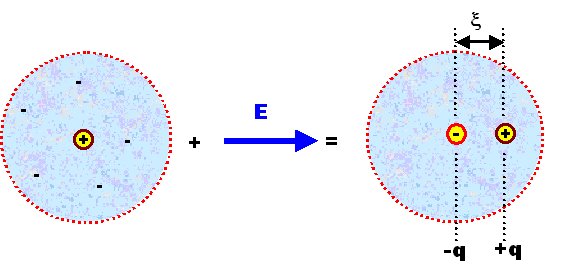
 Imagine a parallel
plate capacitor in which a dielectric material is placed between
the plates (at right below). The dielectric is composed of
atoms/molecules which contain positive and negative
charges. The applied electric field between the plates, E0,
will cause the positive and negative charges of the constituent
atoms/molecules to move slightly in opposite directions
(right). Electric dipole moments will be "induced" in the
material, as shown. The net effect will be for charge to
appear on the surface of the dielectric material as shown.
The dielectric is said to have been polarized, leading to a
polarization electric field, EP.
Imagine a parallel
plate capacitor in which a dielectric material is placed between
the plates (at right below). The dielectric is composed of
atoms/molecules which contain positive and negative
charges. The applied electric field between the plates, E0,
will cause the positive and negative charges of the constituent
atoms/molecules to move slightly in opposite directions
(right). Electric dipole moments will be "induced" in the
material, as shown. The net effect will be for charge to
appear on the surface of the dielectric material as shown.
The dielectric is said to have been polarized, leading to a
polarization electric field, EP. In conductors (metals) there are (almost) free electrons which will move through the material when an electric field is applied, generating an electric current.
 The net E field
between the plates has been reduced,
The net E field
between the plates has been reduced, 
where κ is called the dielectric constant or relative permittivity of the medium.
Note that for a vacuum, since EP = 0, κ = 1 and since EP < E0 for all other materials κ > 1.
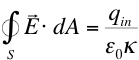
As a general rule when dielectric media is present wherever ε0 appears it must be replaced by ε0κ.
A chemist, a biologist and an electrical engineer were on death row waiting to go in the electric chair.
The chemist was brought forward first. "Do you have anything you want to say?" asked the executioner, strapping him in. "No," replied the chemist. The executioner flicked the switch and nothing happened. Under this particular State's law, if an execution attempt fails, the prisoner is to be released, so the chemist was released.
Then the biologist was brought forward. "Do you have anything you want to say?" "No, just get on with it." The executioner flicked the switch, and again nothing happened, so the biologist was released.
Then the electrical engineer was brought forward. "Do you have anything you want to say?" asked the executioner. "Yes," replied the engineer. "If you swap the red and the blue wires over, you might make this thing work."
Dr. C. L. Davis
Physics Department
University of Louisville
email: c.l.davis@louisville.edu
